
Description
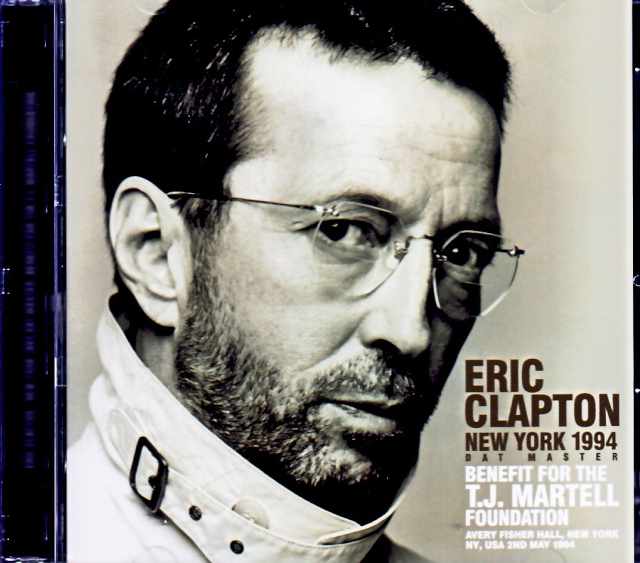
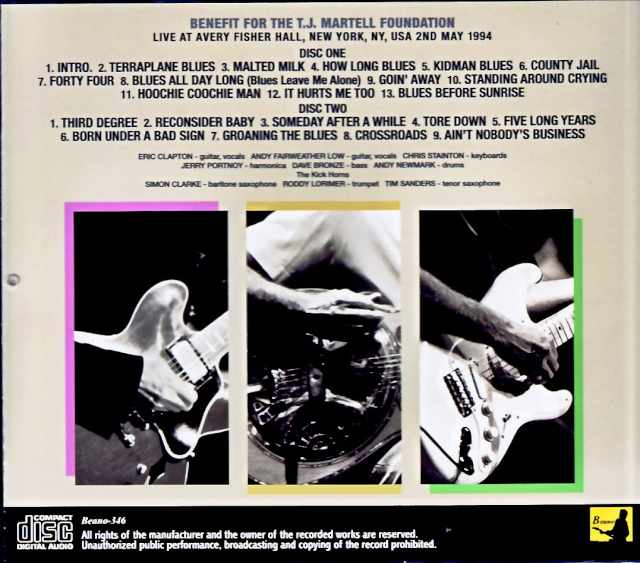
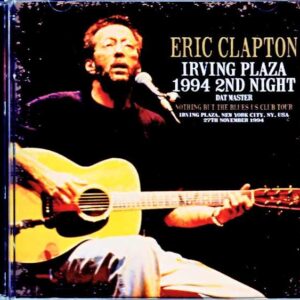
We are proud to present a superb DAT master recording of a charity concert held just before the “Nothing But the Blues” arena tour—a performance marking a true peak in Eric Clapton’s career! While we have previously released numerous acclaimed titles from the 1994 “Nothing But the Blues” tour, this release features the original DAT master of a charity concert that falls outside the scope of both the arena and club tours. Held as a benefit for the T.J. Martell Foundation, this was an exclusive event; tickets ranged from $750 to $3,500, and the evening included a lavish pre-show buffet dinner featuring champagne and caviar, followed by dessert in the Lincoln Center lobby after the performance. Attendees reportedly received a gift package containing an event T-shirt, a special program, and Clapton’s *Unplugged* CD upon departure—underscoring the unique nature of the occasion. The DAT master for this special performance was provided by a renowned UK-based taper with whom we have a long-standing relationship. The sound quality of this master is nothing short of astonishing. The band’s instrumentation and Clapton’s vocals feel incredibly “close.” It offers a unique sense of proximity—distinct from the intimate feel of a small club, the texture of a front-row arena recording, or even the typical “soundboard-like” quality often cited in bootlegs. This is hardly surprising, given the venue: the concert took place in a theater/hall—neither an arena nor a club—as a one-off charity event prior to the official “Nothing But the Blues” tour. While it is undeniably a high-impact stereo audience recording captured from the front row of the hall, the quality of this recording is truly exceptional—surpassing anything we have encountered before. If we were to draw a comparison, imagine a stereo soundboard mix derived from multitrack tapes as one pinnacle of audio quality; the master recording featured here stands as the ultimate example of a stereo audience recording—a pinnacle in its own right. You simply must hear this sound quality for yourself; I am certain it will leave you astounded. While other releases of this concert exist, they pale in comparison to this one—it renders them hardly worth discussing. Furthermore, true to the acclaim surrounding the “Nothing But the Blues” tour, Clapton is in peak form on this particular night. Hearing such incredible playing with such incredible sound quality—that is the ultimate joy of the bootleg experience. Contrast this with the official Martin Scorsese film and its accompanying soundtrack album, *Nothing But the Blues*, which were produced based on the tour but captured the club dates that followed the arena tour. Due to Scorsese’s creative choices regarding the film’s structure, the songs were not presented in their actual performance order, nor was the concert captured in its entirety. Given those factors—and the fact that the official release focused on club venues—this bootleg offers a uniquely valuable experience, delivering a special performance with truly superb audio quality. The “Nothing But the Blues” tour, held between 1994 and 1995, is regarded as a tour where Clapton’s singing and playing reached a transcendent, inspired level. Throughout this two-year run, he never once held back; he played and sang with relentless intensity at every single show. It was a performance style that balanced composure and relaxation with a wholehearted, spirited embrace of the blues. The tour can be seen as a statement of resolve—a moment where he personally defined what the blues meant to him. Why did Clapton return to the blues? To understand why he made that shift in 1994, we must look back at the tragic events of his life. In March 1991, Clapton hit rock bottom emotionally after losing his young son in a tragic accident. However, encouraged by his staff and fellow musicians, he managed to transform that anguish into a cathartic creative process, channeling his feelings for his late son and reflections on his own life into songwriting. During his debut performance on MTV’s *Unplugged*, he also played the blues—a genre he had admired and performed since boyhood. Rediscovering the essence of the blues through that experience, he decided—even while returning to standard touring—to dedicate his annual early-year residency at the Royal Albert Hall in 1993 entirely to the blues. He followed through on this plan and also undertook the recording of *From the Cradle*, a blues-only album he had long dreamed of making but had been unable to realize in his youth. He had previously approached his label, Warner, about producing a blues album, only to be rebuffed with the claim that such a record would never sell. However, the unprecedented success of the *Unplugged* album softened Warner’s stance; they approved the blues project, essentially as a bonus for Clapton, which provided a crucial tailwind. Remarkably, *From the Cradle* followed *Unplugged* by hitting number one on the US album charts—proving that even audiences in the blues’ American heartland craved Clapton’s take on the genre. With the realization of *From the Cradle*, he likely resolved to fully master the blues in his live performances as well. Capitalizing on this momentum, Clapton planned the “Nothing But the Blues” tour, a series of concerts featuring exclusively blues music. Perhaps Clapton realized that it was the blues that had guided him and kept him from losing himself while he was at the emotional nadir of losing his young son. The “Nothing But the Blues Tour” represented a deep return to the blues—a way for Clapton to revisit the music that captivated him in his youth and to express his renewed gratitude to the genre and the pioneers who played it. It is fair to say that Clapton poured an extraordinary level of passion and commitment into this tour. The show was structured to maintain high energy and deliver one highlight after another. Here is a recap of the “Nothing But the Blues Tour” schedule: <1994> Feb 16–Mar 6: UK tour, including 12 consecutive nights at the Royal Albert Hall; May 2: Charity concert for the TJ Martell Foundation at Avery Fisher Hall, New York ←★Here★ ≪Sep 13: Release of *From the Cradle*≫ Sep 28: Filming of tour rehearsals at the Hammerstein Ballroom, New York (later broadcast in the US, Europe, and Japan); Oct 3–Nov 4: US arena tour; Nov 7–Nov 28: US club tour <1995> Feb 15–Mar 7: UK tour; Apr 5–May 5: European tour; Aug 28–Sep 24: US arena tour II; Oct 1–Oct 13: Japan tour. As you can see, the May 2nd performance featured in this release took place in the gap between the UK tour and the “Nothing But the Blues” arena tour; it was essentially a one-off concert. Because it was a charity event, the setlist differed slightly from the main tour, featuring a shortened set. Notably, the show opened with “Terraplane Blues” rather than “Motherless Child”—a choice that made this particular night unique, as that opening song was performed only on this occasion throughout the entire two-year tour. Notably, the band did not play four songs—”Sinner’s Prayer,” “Can’t Judge Nobody,” “Have You Ever Loved A Woman,” and “Crosscut Saw”—that were staples of the main tour; it was truly a special performance. Yet, the set structure remained consistent: transitioning from a seated acoustic set to a standing electric set, the intensity of Clapton and the band surged rapidly as the show progressed. The performance reached a fever pitch of fiery passion toward the end, concluding the main set at its absolute peak. The show ended by stirring the audience’s souls with an unexpected choice for the final encore: “Ain’t Nobody’s Business,” which began with a solo vocal backed only by piano before building to a moving, full-band finale. In the first half, the songs relied on acoustic arrangements or standard riffs, resulting in a solid, if somewhat patterned, performance. However, from the middle section onwards—on tracks that prominently featured guitar solos—Clapton revealed the true essence of a live performer, unleashing a torrent of razor-sharp, completely improvised phrases without a single moment of hesitation. The fluid solos during the Freddie King medley, starting with “Someday After A While,” are also a highlight. The guitar work in the final stretch—particularly from “Five Long Years” onwards—is simply astounding; one marvels at how his fingers can move with such agility. Moreover, this isn’t merely about playing fast; these are phrases infused with Clapton’s unique spirit. Among the tracks, “Groaning The Blues” stands out as the day’s killer tune; the sheer intensity of his playing leaves one speechless. Another highlight is “Born Under A Bad Sign”—a song not performed during the club tour—making this a rare take that captures Clapton channeling the spirit of Albert King. And the performance of “Ain’t Nobody’s Business” that day was superb, too! This song was originally written in 1922 and has been covered by various artists, but Clapton based his rendition on the 1923 version by the pre-war female blues singer Bessie Smith. Clapton sings in a matter-of-fact tone about a life of misfortune—lyrics that say, “Whether I end up penniless or jump into the sea to kill myself, just leave me be.” Yet, at the end, the entire band unleashes an explosion of emotion. Is it a cry of desperation? Or is Clapton shifting gears here to encourage the protagonist, saying, “You mustn’t give up hope; take care of yourself”? The performance is magnificent enough to be interpreted in either way. He played many blues songs on this tour that he had never recorded in the studio, but this track stands out as particularly memorable. Given that he placed it at the end of the regular set, it is certain that Clapton had a specific intention behind the choice. It is also worth noting that during this tour, Clapton used a total of nine different guitars—a record for the highest number of guitars used in a single stage performance in his career (he actually rotated through ten guitars during the tour itself). This was done out of respect for the original blues artists and recordings, in an effort to replicate their specific sounds. Breaking down that attention to detail: ① Martin 000-42 – “Terraplane Blues,” “Malted Milk” ② Dobro – “How Long Blues” ③ Gibson L-5 – “Kidman Blues,” “County Jail” ④ Gibson Byrdland (Brown Sunburst) – “Forty-Four” ⑤ Fender Stratocaster (Blonde Finish) – “Blues All Day Long,” “Going Away,” “Five Long Years,” “Born Under a Bad Sign,” “Groaning the Blues,” “Crossroads,” “Ain’t Nobody’s Business” ⑥ Fender Stratocaster (Black Finish) – “Standin’ Arou…”…and Cryin’ ⑦ Birdland (Blonde finish) – It Hurts Me Too, Blues Before Sunrise ⑧ Gibson ES-335 (Brown Sunburst) – Reconsider Baby ⑨ Gibson ES-335 (Cherry Red) – Someday After a While, Tore Down. Thanks to the superb sound quality of this release, the unique tone of each guitar is captured with precision. We hope you enjoy the meticulous attention paid to Clapton’s guitar tones across every track. This is the definitive version of the special performance held between legs of the “Nothing But the Blues” tour. Benefit for T.J. Martell Foundation, Avery Fisher Hall, New York, NY, USA – May 2, 1994. ULTIMATE SOUND (from Original Masters). A powerful stereo audience recording captured from the front row!! Disc:1 (45:11) 1. Intro 2. Terraplane Blues ★A rare opening choice 3. Malted Milk 4. How Long Blues 5. Kidman Blues 6. County Jail 7. Forty Four 8. Blues All Day Long (Blues Leave Me Alone) 9. Goin’ Away 10. Standing Around Crying 11. Hoochie Coochie Man 12. It Hurts Me Too 13. Blues Before Sunrise Disc:2 (47:13) 1. Third Degree 2. Reconsider Baby 3. Someday After A While 4. Tore Down 5. Five Long Years 6. Born Under A Bad Sign 7. Groaning The Blues 8. Crossroads 9. Ain’t Nobody’s Business Eric Clapton – guitar / vocals Andy Fairweather Low – guitar Chris Stainton – keyboards Dave Bronze – bass Andy Newmark – drums Jerry Portnoy – harmonica Simon Clarke – baritone saxophone Roddy Lorimer – trumpet Tim Sanders – tenor saxophone
Reviews
There are no reviews yet.