
Description
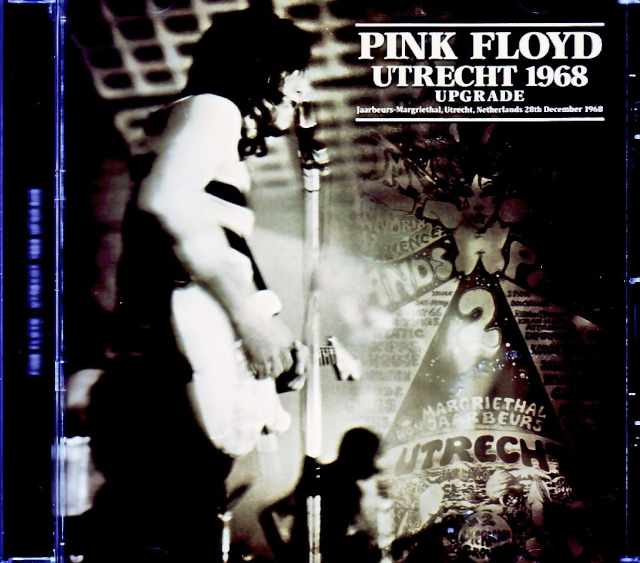
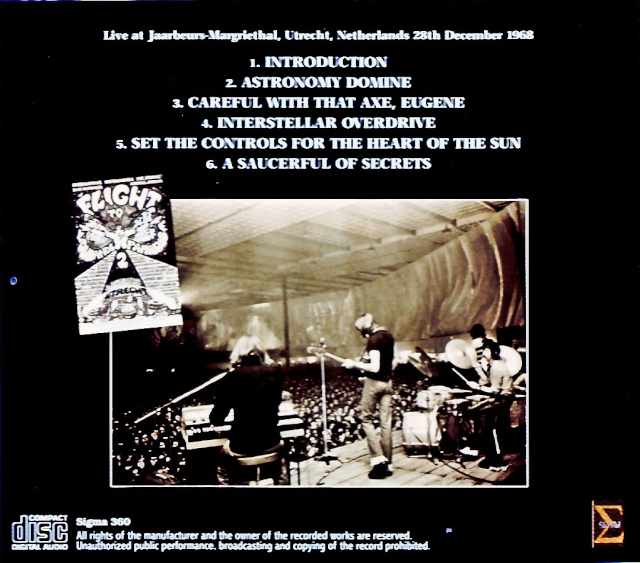
This release captures Pink Floyd in 1968—a pivotal year that saw the departure of Syd Barrett and the arrival of David Gilmour—as they sought to define a new musical direction. We are proud to announce the release of a definitive live album from this formative era, setting a new benchmark for quality! The recording documents the concert held on December 28, 1968, in Utrecht, Netherlands—a legendary audience recording captured during their appearance at the second “Flight to Lowlands Paradise” festival. While the album is packed with highlights, its sheer value as a historical record of 1968 cannot be overstated. Let’s first place this specific night within the context of their activities that year: 1968 — [Jan: David Gilmour joins] Jan 12–20: UK (5 shows) — [Syd Barrett departs] Jan 26–Apr 11: Europe #1 (22 shows + 7 media appearances) — [May 3: *A Saucerful of Secrets* completed] May 3–Jun 29: Europe #2 (27 shows + 2 media appearances) — [Jun 28: *A Saucerful of Secrets* released] Jul 8–Aug 31: North America (21 shows) — Sep 4–Nov 2: Europe #3a (17 shows + 4 media appearances) — [Nov 4: Original “Eugene” recorded] — Nov 7–Dec 28: Europe #3b (19 shows + 3 media appearances) ← ★Here★ — A legendary year-end festival appearance, filling in for Jimi Hendrix. This was Pink Floyd in 1968—a tumultuous year marked by the transition from a chaotic five-member lineup to a new formation following Syd’s departure. As the sheer volume of performances suggests, they were constantly on stage, groping for and attempting to define their own unique sound. The Utrecht concert featured here marks the final show of the “Europe #3” leg, bringing that eventful year to a close. That night was one of chaos. It was the second “Flight to Lowlands Paradise” festival, and the posters had prominently advertised a lineup of heavyweights like the Jimi Hendrix Experience, Jeff Beck, and Jethro Tull. However, none of them actually performed. Whether due to a booking error or a cancellation for other reasons, Pink Floyd was tapped as the replacement act to fill the void. It is hard to believe now, but that was the reality of the era. This recording—a “time capsule” of that event—serves as an invaluable document of Pink Floyd in 1968. Most surviving recordings from 1968 are brief, such as BBC sessions; this is virtually the only source that allows you to hear a full, continuous set lasting nearly an hour. Because of its rarity, this recording has long been a favorite among our customers—often included as a bonus CDR—but this release represents a massive upgrade. “Graf Zeppelin” has polished a newly unearthed master; while the previous version was derived from a cassette tape, this one was digitized from the reel-to-reel master that predated that cassette copy. Although the exact generation count is unknown, it is a low-generation master that stands as the best version in existence. The improvement is so dramatic that it feels like a completely different recording. Every sound is more vivid, but the vocals are particularly striking. Perhaps due to the venue’s PA system, the vocals were originally recorded from a distance; on the old master, they sounded faint—little more than someone saying something far away. While the vocals here still don’t sound “up close,” the vastly improved resolution allows you to clearly follow the melody. Furthermore, the thinness in the low end has been eliminated, finally resolving a long-standing weakness. “Graf Zeppelin” handled the final touches on this new master, removing intrusive gap noise and meticulously correcting the pitch. The opening introduction runs for just under six minutes—more than five minutes longer than on previous releases. The entry into “Celestial Voices” is also extended, allowing the full scope of that night’s performance to emerge more completely. Rendered with a massive upgrade in sound quality, this recording captures a live performance from the band’s dawn—the very first step in their evolution—featuring a version of “Eugene” with its original 1968 arrangement. While the entire set is a highlight, “Careful with That Axe, Eugene” is particularly fascinating. Although it became a live staple for years, the arrangement heard here in 1968 differs from the later standard. To explain the context, let’s briefly review the three early versions: • A (1968): The original studio take, released as a single’s B-side. • B (1969): The live version retitled “Beset By Creatures Of The Deep” during “The Man and the Journey” tour. • C (1970): “The Embryo,” re-recorded for the *Zabriskie Point* soundtrack. Live performances of “Eugene” generally followed the later “Embryo” (C) arrangement. Even the 1969 “Beset By Creatures Of The Deep” (B)—despite the different title—was essentially the “C” arrangement. However, this recording dates to December 28, 1968—less than two months after the original “Eugene” was recorded—meaning it captures a live performance adhering to the original “single arrangement” (A). Recordings of “Eugene” featuring the “A arrangement” live exist only from 1968; from the following year onward, the band shifted entirely to the “C” arrangement, making this a truly invaluable document. The lingering traces of Syd Barrett and the stirrings of a new era following Gilmour’s arrival—to think we would one day be able to experience Pink Floyd in 1968, caught in that transitional moment, with such vivid clarity. This is the definitive edition, meticulously polished from a newly discovered, early-generation master recording—a release that is nothing short of a cultural treasure. It features the legendary audience recording of the December 28, 1968, Utrecht concert. This ultra-rare recording captures a complete 1968 live set; “GRAF ZEPPELIN” has crafted this superior version using a newly unearthed reel-to-reel master, distinct from the previous cassette-sourced masters. It utilizes the best surviving early-generation source, offering a sound quality upgrade so significant it feels like an entirely different recording. This album is a cultural treasure that also allows listeners to enjoy “Eugene” performed with its original single arrangement—distinct from the later “Careful with That Axe, Eugene” style. Jaarbeurs-Margriethal, Utrecht, Netherlands 28th December 1968 (54:16) 1. Introduction 2. Astronomy Domine 3. Careful With That Axe, Eugene 4. Interstellar Overdrive 5. Set The Controls For The Heart Of The Sun 6. A Saucerful Of Secrets
Reviews
There are no reviews yet.