
Description
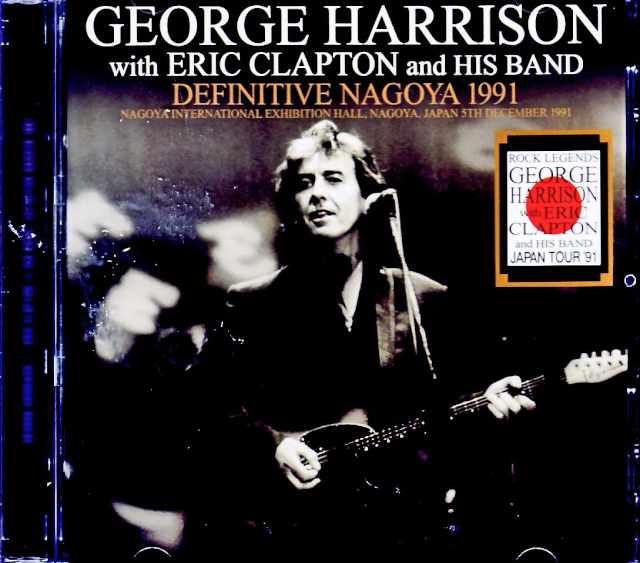
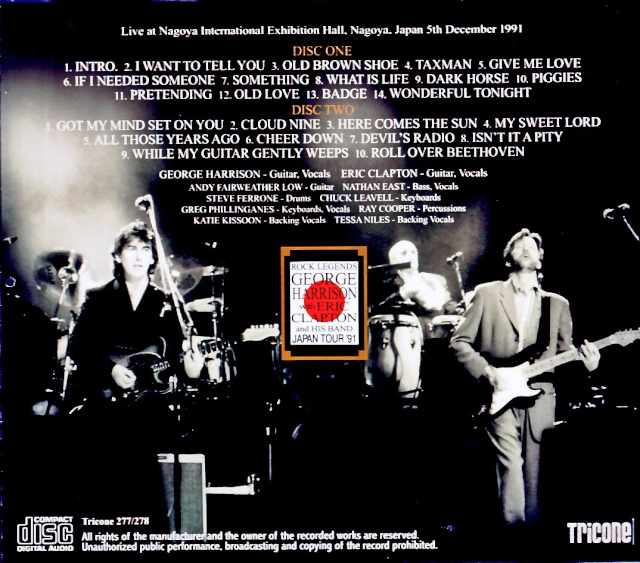
The definitive edition of the George Harrison & Eric Clapton concert in Nagoya on December 5, 1991, has been upgraded! The 1991 “George Harrison with Eric Clapton and His Band” Japan tour has become a legend in the history of Western rock music in Japan, standing as a monumental event that showcased the deep friendship between George Harrison and Eric Clapton. In December 2017, we released “George Harrison with Eric Clapton and His Band – Complete Nagoya 1991,” a truly complete recording of that Nagoya show; it was a massive hit and sold out quickly. Due to its high quality and status as the “authentic Nagoya recording,” there was constant demand for a reissue from those who had missed out. Now, the renowned label Graf Zeppelin has remastered the source material, achieving a dramatic improvement in the sound image, and we are finally releasing this upgraded version. In the previous “Complete Nagoya 1991” release, the performance in the main DAT source was heavily panned to the right; this has now been corrected to a centered position, resolving the issue where the left channel felt lacking. Since the sound of the sub-source used for the final section (from 1:05 into “Devil’s Radio”) was already close to center-panned, this adjustment results in a stable, centered soundstage throughout the entire recording, making for a much more enjoyable listening experience. To those who missed the previous release: the wait is over. This version offers even higher quality. This miraculous concert drew immense attention from fans of both George and Clapton right from the start, and audience recordings of every show on the tour have been released since 1992. Let us share the story behind the release of the previous edition of this Nagoya concert. The quality of the available recordings varies widely, but the audio from the fourth show—held in Nagoya—has seen several releases: first as *FOURTH NIGHT LIVE* (PLATYPUS RECORDS), followed by *ONE MOMENT IN TIME 2* (misterclaudel) in 2003, and finally *NAGOYA 1991* in 2017. All of these releases utilized the same source material—a recording by a specific taper that boasted exceptional sound quality thanks to the use of early-generation DAT technology, which was still a rarity at the time. However, the first two releases suffered from pervasive hiss noise because they relied on second-generation masters created by making an analog copy from the original DAT to a cassette tape. In contrast, the 2017 release *NAGOYA 1991* achieved superior sound quality compared to the previous two versions by utilizing the original DAT master directly. However, because the original recording was made on an early-model DAT recorder with limited battery life, the power ran out during “Devil’s Radio” near the end of the concert; the pitch dropped rapidly, rendering the audio unlistenable. Consequently, *FOURTH NIGHT LIVE* patched the remainder of “Devil’s Radio” onwards with audio from a different show (Tokyo, the 17th) that had significantly poorer sound quality, while *ONE MOMENT IN TIME 2* spliced in a different source from the same Nagoya show—though one with much lower quality than the main DAT master—resulting in a jarring listening experience for both titles. *NAGOYA 1991* mitigated this issue by filling the final section with high-quality audio from the Osaka show; however, it was still disappointing that the source material did not originate from the Nagoya performance itself. While the original DAT master was beyond repair in its initial state, a previously uncirculated, high-quality, and complete master recording of the Nagoya show eventually surfaced. This allowed for a seamless transition: the ultra-high-quality original DAT master was used up to “Devil’s Radio,” and a crossfade was applied during that song to switch to the newly discovered source. This minimized any sense of discontinuity and—by including the uncut encore and the gaps between songs—finally realized a truly complete version of the Nagoya concert. That release was *COMPLETE NAGOYA 1991*. Although the newly discovered master used for the patch did not quite match the pristine quality of the original DAT, it was a high-quality stereo recording in its own right. Of course, *ONE MOMENT IN TIME*… …distinct from the source used for patching in “2,” this recording boasts genuinely high sound quality. While some slight variation in audio character is unavoidable, this release marks the first time the Nagoya performance can be heard from start to finish without any sense of awkwardness—a truly complete document of the show! The primary DAT master is entirely free of hiss and runs at the correct pitch; furthermore, the recording actually begins about six minutes prior to the start point of “FOURTH NIGHT LIVE,” capturing the pre-show intro. It even includes the voice of an audience member near the taper exclaiming “Whoa!” in surprise at the sudden drum attack just before the show began—a charming detail. The alternate master used for patching is excellent in its own right, offering a well-balanced sound mix that clearly captures the drums. Now, thanks to GRAF… Thanks to ZEPPELIN’s remastering, the sound quality has been further enhanced! This allows for a smoother, more enjoyable listening experience that captures the full scope of the Nagoya performance. This release is, in every sense, the definitive version of the Nagoya show! It also highlights the friendship between the two men that made this Japan tour a reality. Let’s look at the tour schedule from that time to understand why this Japan tour became legendary: • Jan 21–29, 1991: Tour rehearsals at The Point in Dublin, Ireland • Jan 31 & Feb 2, 1991: Warm-up shows at The Point • Feb 5 – Mar 9, 1991: 24-day residency at the Royal Albert Hall in London • Sep 4, 1991: Guest appearance at Buddy Guy’s gig at The Roxy in Los Angeles • Sep 26, 1991: Appearance on a comedy show at The Palace in Hollywood, featuring Nathan East as the house band leader; the show aired on the FOX network on Sunday the 29th • Dec 1–17, 1991: Fully backing George Harrison’s Japan tour with his own band — Dec 1: Yokohama Arena (added show); Dec 2 & 3: Osaka-jo Hall; Dec 5: Nagoya International Exhibition Hall ← ★This Release★; Dec 6: Hiroshima Sun Plaza; Dec 9: Fukuoka International Center; Dec 10, 11 & 12: Osaka-jo Hall; Dec 14, 15 & 17: Tokyo Dome As you can see, he was off work from March 9th through September. After wrapping up the previous year’s “Journeyman World Tour” and two consecutive years of grueling residency shows at the Royal Albert Hall, Clapton had intended to take a complete break and enjoy life with his young son, Conor, who had just turned four. However, right in the midst of that, the tragic accident occurred on March 20th. From that point on—to use his own words—Clapton became “like a stone.” Devastated by the loss of his young son, he withdrew from the world and secluded himself in his home. Along with messages from the likes of Keith Richards and Elton John, George Harrison also promptly sent a letter offering comfort and concern. Encouraged by the warm words of his fellow musicians, Clapton managed to keep his mental state stable by attending Alcoholics Anonymous meetings and taking trips out to sea on his manager’s cruiser. During one of his meetings with George, Clapton mentioned that while touring South America the previous year, fans had constantly asked him for news about George. George laughed off Clapton’s suggestion that he should return to the stage and decided to put the idea out of his mind; however, one day, a thought suddenly struck him: “If I asked Eric to help me with a tour comeback, the work involved might keep him busy enough to help him recover from that terrible tragedy.” And so, even though he had no real intention of touring himself, George told Clapton he was planning a return to live performance and asked for his help… …he asked for his help. Although Clapton was surprised by George’s decision, he did not hesitate to lend a hand. He assembled his own band, determined the setlist from George’s repertoire, assigned instrumental roles and selected a third guitarist, arranged the rehearsal venue, and managed the entire schedule. Immersing himself in the busy work of preparing for George’s return to the stage allowed Clapton to take his mind off his own heartbreak. However, even during rehearsals, George reportedly kept saying, “I think I’ll call off the comeback after all.” He was traumatized by the harsh criticism he had received from the media during his 1974 US tour; in truth, he had no desire to perform live again. To persuade him, Clapton suggested touring Japan, a place where audiences listen to music with warmth and genuine attentiveness. That is how the Japan tour finally came to pass. George threw himself into a tour he was reluctant to undertake—all to help Clapton get back on his feet, without letting his true feelings show. Meanwhile, Clapton worked tirelessly to prepare for the comeback George had finally resolved to make. This Japan tour was, in a sense, a testament to the lifelong friendship shared by George and Clapton. As previously mentioned, recordings from every show on the tour have been released; listening to them in chronological order reveals how George’s tension eased and how he regained his true form as the days went by. That transformation was fully realized here in Nagoya. He spoke more to the audience, clearly showing that he had relaxed and opened up. And finally, “Devil’s…” You can now hear high-quality live takes from the Nagoya performance. It is precisely because of this high audio quality that the unique playing on this day becomes apparent! Listening in such high fidelity reveals parts that were previously difficult to hear clearly—most notably, the mid-song solo by Clapton during “Devil’s Radio.” It features a phrasing style—sustaining almost a single note—that wasn’t present in other shows; Nagoya was likely the only venue where he took the solo in this manner. Another highlight is the encore, “While My Guitar Gently Weeps.” Clapton’s solo following the chorus is incredibly emotive—his guitar truly wails! His ferocious hand vibrato explodes, deeply moving the listener. In terms of making the guitar “cry,” this performance rivals the Osaka show on the 10th. I highly recommend listening to these two tracks at high volume. This release is the definitive, upgraded version: it features the first-generation DAT master of the Nagoya show—which boasted the best sound quality of George’s 1991 Japan tour—presented in pristine form, seamlessly spliced with an excellent alternate master of the same show. “COMPLETE NAGOYA 1991” (2CD) – Latest Remaster! In the previous edition, the performance in the main source was heavily panned to the right; this has now been corrected to a center position, resolving the issue where the left channel felt somewhat empty. Since the “sub-source” used for the final section already had a soundstage close to the center, the entire recording now offers a stable, centrally-positioned sound. Nagoya International Exhibition Hall, Nagoya, Japan – December 5, 1991 – ULTIMATE SOUND (from Original Masters) – UPGRADE!!! Disc 1 (77:36) 1. Intro 2. I Want To Tell You 3. Old Brown Shoe4. Taxman 5. Give Me Love 6. If I Needed Someone 7. Something 8. What Is Life 9. Dark Horse 10. Piggies 11. Pretending 12. Old Love 13. Badge 14. Wonderful Tonight Disc 2 (62:06) 1. Got My Mind Set On You 2. Cloud Nine 3. Here Comes The Sun 4. My Sweet Lord 5. All Those Years Ago 6. Cheer Down 7. Devil’s Radio ★Different sound source from 1:05 onwards until ending 8. Isn’t It A Pity 9. While My Guitar Gently Weeps 10. Roll Over Beethoven George Harrison – guitar / vocals Eric Clapton – guitar / vocals Andy Fairweather Low – guitar Chuck Leavell – keyboards Greg Phillinganes – keyboards Nathan East – bass / vocals Steve Ferrone – drums Ray Cooper – percussion Katie Kissoon – backing vocals Tessa Niles – backing vocals
Reviews
There are no reviews yet.