
Description
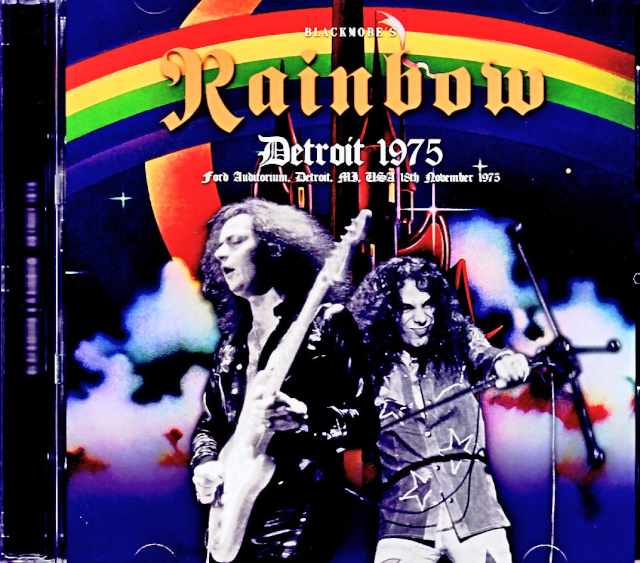
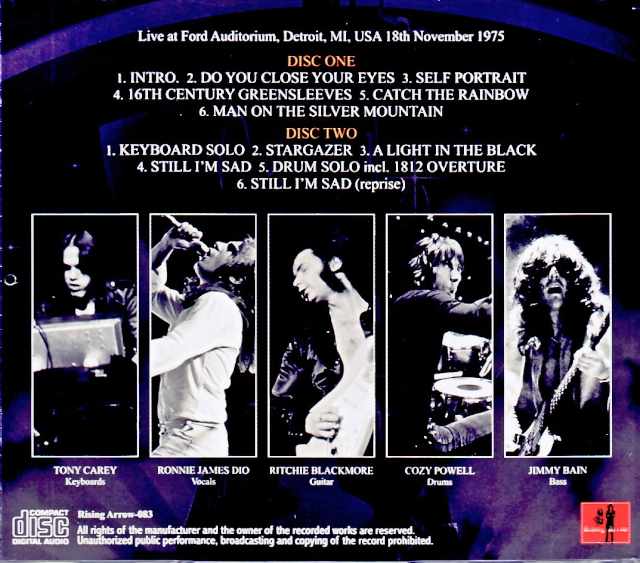
Among the Rainbow collection, the period of “November 1975” radiates a special brilliance unlike any other. Now, a live album capturing the pinnacle of that era has been refined and polished. A new 2-CD set, boasting sound quality that sets a new benchmark, is set for release. This title captures the concert held in Detroit on November 18, 1975—specifically, the legendary audience recording from that night. 1975 was the band’s dawn; “Kill The King” had not yet been born, and “Do You Close Your Eyes” held the prime opening slot. Two renowned recordings have long vied for the crown as the definitive record of this peak period. One is the New York recording *Beacon Theatre 1975*, which recently received an upgrade. The other is the Detroit recording—the very title presented here. Like *Beacon Theatre 1975*, this release represents the ultimate edition, with the best available master source meticulously remastered by “Graf Zeppelin” to achieve superior sound quality. How do these “twin peaks” of recordings relate to one another? As always, let us examine the context by looking at the band’s activities during that time. 1975: April 7 – Ritchie leaves Deep Purple; August 4 – *Ritchie Blackmore’s Rainbow* released; September – Lineup finalized; November 10–29 – North American Tour #1 (12 shows) ← ★Here★. 1976: February – Production of *Rising* begins; May 15 – *Rising* released; June 11–August 7 – North American Tour #2 (32 shows); August 31–September 14 – UK Tour (10 shows); September 20–October 18 – European Tour (20 shows); November 4–22 – Australian Tour (11 shows); December 2–16 – First Japan Tour (10 shows); February 1977 – Jimmy Bain dismissed. This is the story of Rainbow in 1975 and 1976. The only live performances held in 1975 were part of the “North America #1” tour; the lineup of Cozy Powell, Jimmy Bain, and Tony Carey was already in place, yet production of the *Rising* album had not yet begun. Let us narrow our focus to the schedule and review the available recordings. Details of “North America #1”: Nov 10 (Montreal) [*Beacon Theatre 1975*]; Nov 13 (Waterbury) [*Definitive Hempstead 1975*, *Definitive Philadelphia 1975*]; Nov 16 (Akron) [*Pittsburgh 1975*]; Nov 18 (Detroit) [**This Title**]; Nov 22–29 (4 shows). This release features sound quality that sets a new benchmark, achieved by converting the audio to true mono. It was a mini-tour of only 12 shows, and this Detroit performance was the eighth—marking the latter stage of the run. It stands in contrast to the *Beacon Theatre 1975* recording, which captured the tour’s opening phase. As previously mentioned, these two legendary recordings (New York and Detroit) have long vied for the title of “best,” yet the Detroit recording suffered from a persistent flaw: degradation of the right channel. In the 1970s, audience recordings were typically made by capturing a mono microphone signal onto stereo tape, meaning both channels contained essentially the same audio. However, over time or through repeated dubbing, the channels would degrade unevenly. In the case of the Detroit recording, the right channel was plagued by constant error noise and hiss, along with frequent fluctuations in the sound. Previous releases were consistently held back by these issues with the right channel—flaws that have finally been overcome in this release. Rather than simply remastering a previously released CD, “GRAF ZEPPELIN” has gone back to the source—the superior master tape unearthed by the renowned “JEMS” archive—and polished it anew. While they employed their usual array of techniques—such as noise reduction and frequency-balanced adjustments—to recreate the “sound as it was heard in 1975,” the decision to convert the audio to mono yielded particularly impressive results. By correcting significant phase misalignment, repairing the pristine left channel, and creating a true mono mix, they achieved a dramatic improvement. Defects in the right channel were completely eliminated, the soundstage locked firmly into the center, and the contours of the bass and kick drum became strikingly distinct. The overall sound gained a rich, meaty fullness, creating an impactful presence that makes the performance feel immediate and close. This upgrade perfectly complements the unique character of the recording, bringing out its inherent appeal: “rock-and-roll power.” The *Beacon Theatre 1975* and Detroit recordings have long vied for the top spot, yet they possess vastly different sonic personalities. While *Beacon Theatre 1975* is prized for its beautiful, wide, and delicate soundscape, the Detroit recording shines through its powerful, direct impact. To use a *Kamen Rider* analogy, one might call *Beacon Theatre 1975* the “Technique” version and the Detroit recording the “Power” version. In this release, that raw power is concentrated into a single point at the center, striking the listener with an intensity that hits right between the eyes. The greatest beneficiary of this powerful sound is undoubtedly the drumming of a young Cozy Powell; the thick mid-to-low range vividly captures his playing, delivering earth-shaking percussive impact throughout the entire performance. You simply must listen—preferably on headphones—to the moment right after Ritchie’s solo in “Stargazer,” where Cozy launches into a drum fill (around the 8:08 mark)! Each crisp, vivid strike showcases a powerhouse dynamism that shatters the song’s ethereal atmosphere, immediately followed by Ronnie’s vocals roaring to life. That raw power carries seamlessly into “A Light In The Black.” On “Still I’m Sad,” Cozy’s drumming—powerful enough to shake the venue to its foundations—continues unabated even as the track surges through the climactic “1812 Overture.” To put it bluntly, Cozy is the star of this recording. This release represents the definitive answer regarding the “Twin Peaks” of the band’s journey—a conclusion reached after half a century. Of course, it isn’t just about Cozy; the early part of the set offers Ritchie’s lyrical phrasing on tracks like “16th Century Greensleeves” and the first half of “Catch The Rainbow,” while the conversion to mono has stabilized the sound, allowing Ronnie’s vocals to stand out with greater clarity than ever before. You can fully enjoy this approximately 92-minute complete show with a sound that is both powerful and stable. Will you choose the New York recording for its delicate, expansive “technique,” or the Detroit recording for its fat, forceful “power”? With the recent release of *Beacon Theatre 1975* alongside this title, the “Twin Peaks” of 1975 Rainbow—the definitive versions of this era—are finally complete after fifty years. This is a pinnacle release from the band’s early days—an essential, standout addition to any Rainbow collection. It features the legendary audience recording of the November 18, 1975, Detroit concert. This definitive edition has been polished by Graf Zeppelin using the best master from the renowned “JEMS” archive; precise conversion to mono has eliminated imperfections while maximizing the recording’s inherent power. This is the definitive release that, alongside *Beacon Theatre 1975*, forms the “Twin Peaks” of the 1975 Rainbow era. Ford Auditorium, Detroit, MI, USA – November 18, 1975. Disc 1 (44:22): 1. Intro. 2. Do You Close Your Eyes 3. Self Portrait 4. 16th Century Greensleeves 5. Catch The Rainbow 6. Man On The Silver Mountain. Disc 2 (47:37): 1. Keyboard Intro (Note: Some releases label this as “Keyboard Solo”) 2. Stargazer 3. A Light In The Black 4. Still I’m Sad 5. Drum Solo feat. 1812 Overture 6. Still I’m Sad (Reprise). Ritchie Blackmore – Guitar; Ronnie James Dio – Vocals; Cozy Powell – Drums; Jimmy Bain – Bass; Tony Carey – Keyboards.
Reviews
There are no reviews yet.