
Description
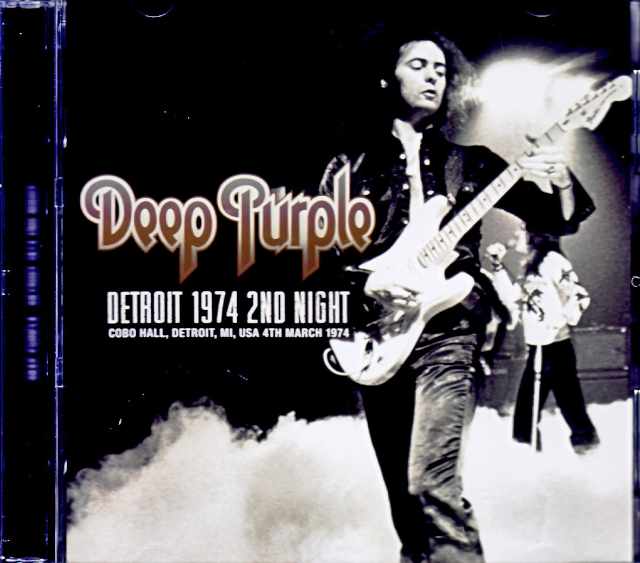
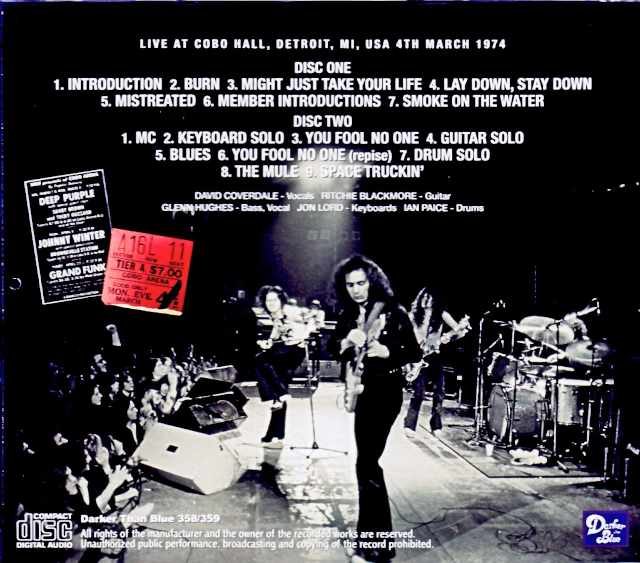
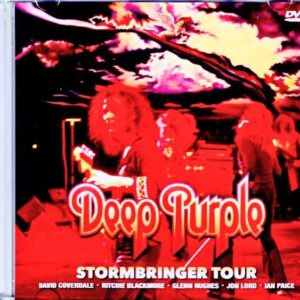
In 1974, the third iteration of Deep Purple raised the banner for their nationwide invasion, leading up to the legendary California Jam. This release permanently preserves the “Detroit performance on March 4, 1974,” a legendary audience recording of that tour’s opening show. Speaking of the third iteration’s nationwide invasion, the recently released “Pittsburgh 1974” is still fresh in our memories, but this is an even earlier record. To understand the situation, let’s first explore the show’s place within the overall context of that time. 1973 (September: Phase III begins → November: “Burn in Brussels” completed) December 9-17: Europe #1 (5 shows) ← *BURN IN BRUSSELS 1973 1974 (January 20-26: Europe #2 (5 shows) March 3-April 9: North America #1 (26 shows) ← ★HERE★ April 18-June 27: UK (24 shows) ← *Official LIVE IN LONDON etc. August 24-30: North America #2 (4 shows) ← *HARTFORD 1974 etc. (September: “The Storm Messenger” completed) September 18-28: Europe #3 (9 shows) ← *MUNICH 1974 November 13-December 17: North America #3 (19 shows) ← *LONG BEACH ARENA 1974 etc. January 25, 1975: “SUNBURY ’75” (March 14: “The Conqueror of the Silver Mountains” completed) March 16 – April 7: Europe #4 (12 shows) ← *Official MADE IN EUROPE etc. (Ritchie Blackmore leaves the band) This is the oldest record capturing the start of their US invasion. This is the journey of the third iteration of DEEP PURPLE. They began live activities immediately after the completion of “Purple Fire,” but “Europe #1” and “Europe #2” were merely short legs to warm up the new lineup. The real start came with “North America #1” in the new year. Both the aforementioned “PITTSBURGH 1974” and this work are records of this “North America #1.” Let’s focus on the dates in more detail. Details of “North America #1” – March 3: Detroit performance (first day) * March 4: Detroit performance (second day) ←★This work★ – March 5: Buffalo performance * March 6 ‘PITTSBURGH 1974’ – March 8 – April 4 (19 performances) * April 6 ‘CALIFORNIA JAM 1974’ etc. – April 7: Tempe performance * April 9 ‘LIVE IN SAN DIEGO 1974 (official)’…and so on. The US tour, originally scheduled to start on February 9, was canceled after several schedule changes due to Jon Lord’s illness. It was restarted in March. Two consecutive performances were scheduled at the same venue, Cobo Hall in Detroit, and this work is from the second day. Since the existence of a recording of the first day has not been confirmed, this work is effectively the oldest record of the 1974 North American tour. The band that would later electrify the entire nation at California Jam landed in the New World about a month later. This recording perfectly captures their fresh potential. Meticulous mastering restores the original brilliance of the recording. This recording was known among traders for some time, but it had rarely been released as a live album. However, this time, a new, top-of-the-line master has emerged. This new master is the latest transfer, newly digitized from analog cassette by the renowned collector “Lucifer Burns.” This release is the top-of-the-line updated version, with meticulous mastering by “GRAF ZEPPELIN” on this much-talked-about new master. In fact, the sound is the best it’s ever been. To be honest, even the older trader recordings were known as fairly good audience recordings (albeit slightly distant), and some even said to be clearer than the Pittsburgh recording from two days later. However, even though the recording itself was excellent, it was difficult to say that the quality of the material was fully utilized. The previous masters were plagued by hiss noise, low-frequency distortion, and pitch inaccuracies and distortions throughout due to deterioration. It could never become anything more than “known only to a select few.” Of course, this work is different. Not only has the accuracy been improved with the latest transfer technology, but the mastering by “GRAF ZEPPELIN” has thoroughly unearthed the potential of the recording itself. As always, every technique has been put into it, but the noise processing was particularly effective this time. The jarring hiss noise—especially the loud, sustained high-frequency hiss that was constantly ringing out in the left channel—has been properly processed in conjunction with frequency band correction. Rather than simply cutting it out, the frequency band in which the performance sounds breathe has been carefully identified, and unwanted components have been stripped away to the absolute limit without affecting the musical sound. The ironclad rule of noise processing that does not distort the performance sound has been thoroughly applied here as well. Of course, the various balance adjustments are also superb. Through correction based on frequency band analysis, the distortion in the low frequencies has been tidied up, and the sound image has transformed into something clear and transparent. In addition, the meticulous pitch correction is not a uniform adjustment, but even the occasional sound distortions have been carefully corrected one by one with obsessive precision. Furthermore, the entire recording has been converted to mono after phase correction that does not allow for even a 1/1000th of a second of error. As mentioned in the liner notes for the simultaneously released “NEW YORK 1973 FINAL NIGHT,” audience recordings of this era were basically “monaural microphone + stereo tape,” and this work is also originally a mono recording. By converting to mono, not only is the original sound restored, but a solid sense of stability is also restored. The moment when Deep Purple’s third phase began its invasion of America And perhaps the most interesting thing about this work is the atmosphere of the audience that seeps out of the recording. Although the band’s popularity had soared after the North American hit of “MADE IN JAPAN” the previous year, the transition to the third phase meant that almost all of the setlist had been changed. Moreover, the frontmen were two unknown newcomers. Fans who came expecting “Deep Purple from MADE IN JAPAN” could not hide their bewilderment, and it was relatively quiet during the performance and between songs (which is a blessing for us who are listening to the recording). However, that is precisely why it is worth listening to. While they had already taken a step forward from their initial exploratory approach on “PITTSBURGH 1974” two days later, this album captures the second show of the tour. The performance is even more solid, and they are carefully trying to solidify their stage presence. Even amidst this, Glenn Hughes inserts his signature high notes and shouts at various points, asserting his presence as the frontman of the new band (though he hasn’t yet reached the unrestrained, wild style of his later years). After the great success at California Jam, both Coverdale and Glenn gained confidence, and the band’s ensemble would eventually undergo a major transformation. What is captured on this album is even closer to that major turning point. It captures the raw atmosphere of the first night the new band ventured into America, where you can still feel the audience’s bewilderment. The oldest record of the third iteration of Deep Purple’s invasion of America has been realized as the first ever pressed album. The latest transfer + GRAF ZEPPELIN’s meticulous mastering brings out the potential of the material, allowing you to experience the band as it was before California Jam. Listening to this alongside “PITTSBURGH 1974” reveals even the band’s transformation in just two days. This is an audience recording of their “Detroit performance on March 4, 1974.” It’s the second show of their first US tour of their third phase and the oldest record of their time in the US. Lucifer Burns’ latest transfer has been polished by GRAF ZEPPELIN to the highest quality for this first pressing. This is a cultural heritage album that lets you experience the band’s experimental spirit before the California Jam. First time this recording has appeared on the label! Latest digital transfer from analog cassette by Lucifer Burns, who is well-known for his rare recordings! The entire recording has been thoroughly repaired and converted to mono. The significant hiss noise has been appropriately processed through frequency correction, and pitch and tone distortion have also been corrected as needed. The occasional tone distortions that were present in some places are now almost unnoticeable. It has a somewhat gritty sound, but you can enjoy a consistently stable sound throughout. Cobo Hall, Detroit, MI, USA 4th March 1974 TRULY AMAZING/PERFECT SOUND UPGRADE!!! Disc 1 (38:41) 01. Introduction 02. Burn 03. Might Just Take Your Life 04. Lay Down, Stay Down 05. Mistreated 06. Member Introductions 07. Smoke On The Water Disc 2 (44:38) 01. MC 02. Keyboard Solo 03. You Fool No One 04. Guitar Solo 05. Blues 06. You Fool No One (reprise) 07. Drum Solo 08. The Mule 09. Space Truckin’ Ritchie Blackmore – Guitar David Coverdale – Vocals Glenn Hughes – Bass & Vocals Jon Lord – Keyboards Ian Paice – Drums

Reviews
There are no reviews yet.