
Description
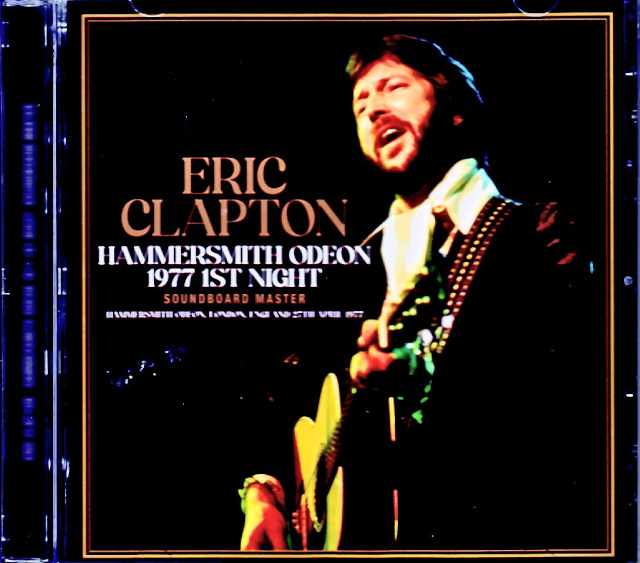
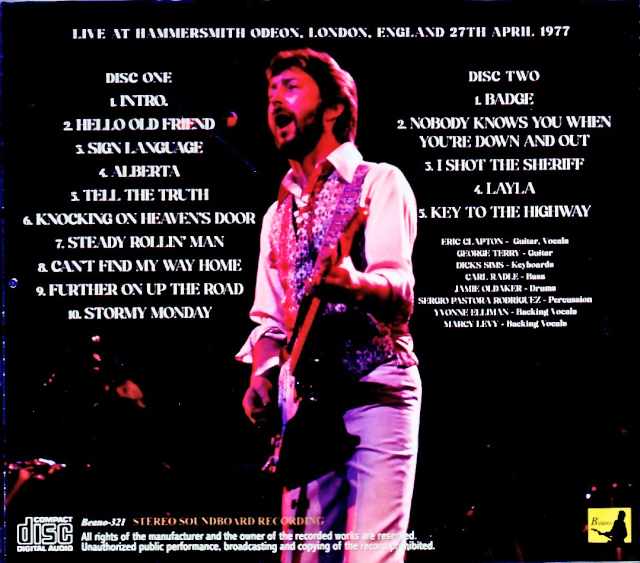
We’ve acquired the original soundboard master of the classic 1977 live recording! Taper, a veteran of Eric Clapton’s treasured recordings in the UK, has brought us another new master. This is the stereo soundboard master from the first day of Clapton’s consecutive performances at London’s Hammersmith Odeon on April 27, 1977. While there are several previously released versions of this performance, this is a digital copy of the original first-generation master. The 1977 live recording was thought to have been 16-track (the 1973 “Rainbow Concert” was recorded on a mobile unit, with 8-track), but this is a digital copy of the original master, meticulously mixed down to 2-track stereo by the original engineers. The original bootleg master was a cassette copy reflecting the analog era, so you can hear the difference in freshness with this new master. In other words, this is the first-generation master that served as the source of all previous bootleg masters. This is especially evident in the bass noise. Carl Radle’s bass amplifier malfunctioned almost throughout the entire performance, causing a constant buzz. This noise was detected on previously released recordings and was thought to be due to the master, but it’s not apparent on this recording’s master. This suggests that the distortion of the bass sound on previously released recordings may have increased as the master generations evolved. While slight bass distortion can be detected on this first-generation master, it’s not at a level that’s noticeable. This alone speaks to the excellence of this master. Furthermore, this live recording was included in full on the official 2012 release, “SLOWHAND 35TH ANNIVERSARY EDITION,” but the mix is significantly different. The official recording featured high-sound pressure and a more flashy mastering style, reflecting the mixing trends of the time. The audience cheers were intentionally mixed loudly to exaggerate the excitement. However, the biggest difference is that while the positioning of each instrument and vocal is basically the same, the official release mixes the percussion of Sergio Pastora Rodriguez, who was in the band at the time, quite off-key. Listening to this release, you’ll notice that his percussion is clearly captured in the center, slightly to the right, channel, from the opening number onward. This groove clearly conveys the excitement of each song. However, on the official release, this percussion is barely audible, buried in the band sound (the organ is intentionally mixed louder instead). Depending on the listener’s preferences, the original master had this vibrant percussion well mixed in (even Yvonne Elliman’s shaker sounds are clearly audible). Furthermore, at 4:35 in “Steady Rollin’ Man,” Clapton forgets to sing a certain part, but the official version compensates for this by bringing in vocals from elsewhere. This work clearly shows that these artificial measures were also taken on the official version. Also, this work’s opening section is 54 seconds longer than the official version. While the official version starts the opening number abruptly, this work starts with Clapton appearing on stage and matching his breathing with the band members while playing instruments. Furthermore, the inter-song segments that were cut throughout the official version are also fully recorded. Clapton’s unvarnished, top-notch performance. This is the true master of the day. It’s packed with charms you won’t find on official or previously released versions. The ultra-clear, superb sound quality of the top-notch stereo soundboard recording is brought back to life along with the atmosphere of the famous Hammersmith Odeon venue. It’s a world apart from the previous day’s TV recording! Clapton is here in top form! 1977 was a time when Clapton had pretty much established himself as a solo artist, with every album he released consistently reaching the top 20 on the charts. Let’s take a look at Clapton’s activities that year. February 14: Appeared at a charity concert in Cranley, Surrey, England (with his band, “Eddie Earthquake & His Tremors”). April 20-29: Short UK tour (here). June 4-20: Short European tour. August 5: Spot performance in Iviza, Spain. August 11: Followed by a performance in Barcelona. September 26-October 7: Japan tour. October 9-10: Concerts in Honolulu, Hawaii. In between these schedules, in May, Clapton recorded the classic album “Slowhand” at London’s Olympic Studios. After completing the album, he embarked on a short tour and a spot performance in Spain. However, the setlist for the April tour, as before, featured songs from his previous album, “No Reason to Cry.” In fact, the day before this release, Clapton appeared on the BBC’s famous live show, “The Old Grey Whistle Test (OGWT).” He was drunk, and the live television recording environment seemed to be a challenge for him, resulting in a lackluster performance from the beginning to the middle of the set. Since it was the day after that, one might assume he was still drinking heavily, but on this day, he was completely unaffected, delivering a completely different performance, as if the previous day had never happened. The setlist for this night also featured songs from the album, and the first two tracks were of this nature. These two tracks were well-played, exuding the country-inspired flavor of the album. Then, around the time of “Tell the Truth,” when he switched to a Blackie Strat, Clapton’s sharpness really began to shine. It’s safe to say that Clapton’s performance is best captured in tracks that include guitar solos. The long solo on the 1974 track “Steady Rollin’ Man,” a rare set piece, is also exceptionally sharp. This track’s edgy, flowing playing is arguably the highlight of the first half. Clapton’s playing is also outstanding in the tempo-varying blues sequences of “Further On Up the Road” and “Stormy Monday.” The latter is a rousing performance that stretches for over 12 minutes. From here, the momentum only builds from there toward the second half. The middle solo of “Badge” boasts a powerful wah-wah phrasing, and Clapton’s wah-wah solo in the concluding section of “I Shot the Sheriff” is also excellent. The drum and percussion solos in the second half make this a 13-minute blast, a truly captivating performance. Layla, who didn’t perform during the previous day’s TV recording, also “attacks” with a groovy performance (though the missed chords at the beginning of the third chorus are a charming detail). Of course, the solo in the postlude is excellent in both phrases and sharpness. Encore’s Key to the Highway also has a sense of stability that is nothing other than a rock-solid performance. Clapton was in top form throughout the day. A true 1st generation master who captured Clapton in top form and has not taken any artificial measures in mixing! Hammersmith Odeon, London, England 27th April 1977 STEREO SBD(from Original Masters) UPGRADE!!! Disc:1 (61:46) 1. Intro 2. Hello Old Friend 3. Sign Language 4. Alberta 5. Tell the Truth 6. Knocking on Heaven’s Door 7. Steady Rollin’ Man 8. Can’t Find My Way Home 9. Further On Up the Road 10. Stormy MondayDisc:2 (42:08) 1. Badge 2. Nobody Knows You When You’re Down and Out 3. I Shot the Sheriff 4. Layla 5. Key to the Highway Eric Clapton – Guitar / Vocals George Terry – Guitar Dicks Sims – Keyboards Carl Radle – Bass Jamie Oldaker – Drums Sergio Pastora Rodriguez – Percussion Yvonne Elliman – Backing Vocals Marcy Levy – Backing Vocals STEREO SOUNDBOARD RECORDING
Reviews
There are no reviews yet.